Showing posts with label COMPANIES. Show all posts

1.22.2008

COMPANY: Oxonica

Overview
Oxonica is a publicly traded international nanotechnology company with subdivisions in energy, healthcare, materials, and security. Oxonica was founded in 1998 by Prof. Peter Dobson and Dr. Gareth Wakefield out of the Universit of Oxford. The company was founded around a c
ore set of patents encompassing nanoparticles and coatings that Oxonica sought to use in diagnostics, fuel additives, metal coatings, and topical treatments. Oxonica has U.S. offices in Mountain View, CA for its healthcare and security divisions and reported a gross profit of £6M from £10.3M revenue in 2006.

www.Oxonica.com

Products
Oxonica's commercialized products are Envirox™ and Optisol™ from the energy and materials divisions, respectively, and the Nanoplex™ system is currently under development in the healthcare division.

Envirox™- A fuel born catalyst designed as an additive in diesel engines to reduce fuel consumption and emission. Technologically, Envirox™ is engineered from cerium oxide to make it active enough to be added at 5 mg/L of diesel. The catalyst acts by lowering the combustion temperature of carbon in the combustion chamber and improving the oxidation of unburnt fuel and carbon deposits. Refer to this pdf for more info.

Optisol™- A UV absorber used as an additive in sun-care and anti-aging products. Optisol™ is produced by incorporating manganese ions in the the major titanium dioxide component of the product. This provides a major competitive advantage, as the manganese ions cause Optisol™ to absorb free radicals and prevent them from harming the body.

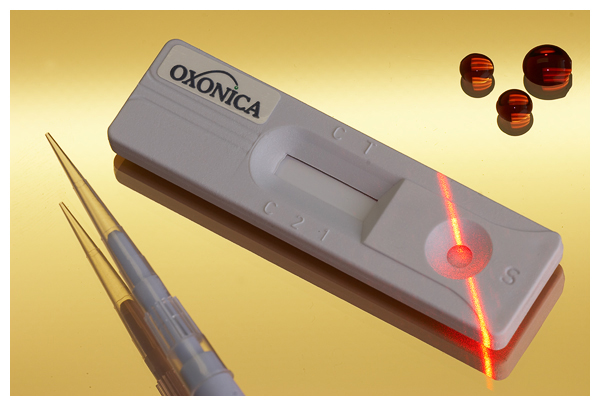
Nanoplex™- Oxonica's acquisition of Nanoplex, Inc. in 2006 provided the company with Nanoplex™ system, which is a cost effective system capable of performing high throughput detection of multiple particles within human samples. The system uses gold nanoparticles, which are coated with Raman-activated dye and SiO2, and conjugated with antibodies that recognize targets within a tissue or blood sample. Through a process called Raman Scattering, the targets can be detected in stereotypical readouts that are analyzed by the physician. The major advantage of this system is its speed (under 30 min) and its ability to detect multiple targets in a single sample.

News
12.13.2007- Oxonica's security division completes technological milestones, prompting the business to receive $275K in follow-on orders from a total of $1.16M promised upon further completion of milestones.

9.27.2007- Oxonica signs a follow-on R&D agreement with Becton Dickinson, a major pharma company interested in the
Nanoplex™ system. Under the terms of the agreement, BD will fund the development of Nanoplex™ to evaluate its use in clinical situations.

10.19.2006- Oxonica is named by Lux Research to be one of four nanotechnology startups of the greatest value to corporate partners.

7.6.2006- Oxonica's platform detection technology wins Nanotech Briefs Nano 50 Award.

(FIGURE from Nanotech-now.com)

5.30.2007

COMPANY: Nanoident Technologies

Overview
Nanoident Technologies is a privately held company founded in 2004 out of Austria with the aim of printing semiconductors, biometric assays, and photonic lab-on-a-chip systems with a method similar to that utilized by nanosolar. Nanoident has two major subsidiaries. The Austrian-based Nanoident Biometrics prints biometric sensors for security purposes, while Bioident Technologies, based in Menlo Park, CA, prints opto-electronic capabilities on lab-on-a-chip systems for diagnostics. Details on the financial investments made into Nanoident are unknown, but CEO Klaus Schröter claims to have received no venture capital money to fund R&D.

www.Nanoident.com


Subsidiaries
Bioident Technologies- Bioident prints opto-electronic capabilities on semiconductor based photonic lab-on-a-chip systems for detection of biological agents in food, water, and blood or tissue samples for diagnotic purposes. Bioident's technology integrates microfluidic lab-on-a-chip systems with printed light emitting and detecting electronic interfaces to create a novel platform in which samples can be easily illuminated and detected in real time for detailed analysis.

Nanoident Biometrics
- Nanoident biometrics prints biometric sensors for use in identification softwares. Nanoident's biometric sensor are printed for touch screening, and test for fingerprints as well as blood and skin parameters on the surface of the finger. Nanoident seeks to use this technology
in next generation wireless and internet communication, payment systems, as well as other identification solutions.

Products
Semiconductor 2.0- This is Nanoident's platform for printed semiconductor-based products. This printing process allows for custom designed devices to be produced at a fraction of the cost as traditional semiconductor fabrication plants.

PhotonicLab- This platform enables real-time, in-situ and multi-parameter detection and analysis capabilities for lab-on-a-chip systems. The technology improves on the capabilities of traditional lab-on-a-chip technology while maintaining the cost-effectiveness inherent in the technology.

News
3.08.2007- Bioident receives the 2007 Frost & Sullivan enabling technology of the year award

3.08.2007- Biodent announces first complete lab-on-a-chip system based on printed semiconductor technology

3.13.2007- Nanoident opens first manufacturing plant for printed opto-electronic semiconductor sensors

9.18.2006- Bioident technologies opens U.S. headquarters in Menlo Park, CA

6.26.2006- Nanoident announces its biometrics division

11.28.2005- Nanoident builds the world's first factory for organic semiconductor sensors

10.10.2005- Nanoident wins the coveted Austrian Innovation award

6.30.2005- Nanoident presents first high resolution photodetector based on organic semiconductors

(FIGURE from Nanoident.com)

4.16.2007

COMPANY: Nanophase

Overview
Nanophase was founded in Romeoville, IL in 1989 and is currently publically tra
ded with a market cap of $130M. Nanophase is one of the first companies founded in the nanomaterials field and specializes in manufacturing metal-oxide powders for use in a wide variety of applications, including personal care, semiconductors, optics, and environmental catalysts. Nanophase's business model relies on partnerships with businesses in target markets. Nanophase's current exclusive partnerships with BASF, Rohm, and Haas Electronic Materials brought in $9M in revenue in 2006, and is reporting first quarter revenues of $2.9M in 2007, representing a year-over-year growth of 45% - the highest in the field.

Nanophase.com

Technology
Nanophase produces nanocrystalline powders containing nanoscale grains with properties capable of enhancing the performance of other materials. Nanophase has produced powders designed to enhance the chemical, mechanical, electrical and optical behavior of materials. Nanophase has combined methods of Physical Vapor Synthesis and Nanoarc Synthesis with a patented polymer coating to manufacture a variety of nanocoatings, including some that are compatible with fluids - a feat unmatched by current competitors.

Applications
Antimicrobial- Powders have been developed with antimicrobial properties to aid in the preservation of certain materials including wood, plastics, textiles, and materials subjected to harsh conditions.

Catalysts- Nanomaterials can be used as catalytic converters for more efficient emissions in fuels or for the creation of fuel cells.

Performance Coatings- Powders can be used as coatings to dimish the effects of UV rays, static charge, and general abrasion on materials.

Personal Care- Nanomaterials can be used as sunscreens, deodorants, dental coatings, and antibacterial coatings in personal care products.

Polishing- Nanophase's uniquely blended polishes can be used for high-quality semiconductor or glass polishing.

Products
For a list of Nanophase's products, see their catalog.

Collaborations
BASF- Nanophase partners with BASF for sunscreen and personal care applications.

Rohm & Haas- This partnership is largely for semiconductor applications.

BYK Chemie- For coatings and ink applications.

Alfa Aesar- For research sample distribution.

(FIGURE from NSTI.org)

4.04.2007

COMPANY: Arrowhead Research

Overview
Arrowhead Research Corporation is a publicly traded company based in Pasadena, CA with a market cap of around $160M. Arrowhead focuses on developing nanotechnology with sponsored research grants to top institutions and through research and development within its subsidiary companies, Aonex Technologies, Insert Therapeutics, Calando Pharmaceuticals, and Unidym. Arrowhead's business plan involves commercializing nanotechnology products owned by its subsidiaries, funding nanotech R&D in exchange for licensing rights, and acquiring IP for nanotechnologies.

Subsidiaries
Aonex Technologies- Specializes in nano-enables semiconductor fabrication to reduce costs, improve performance, and integrate multiple functions into a single device. The technology under Aonex has many applications in electronics, but the major focus is currently on next-generation solar cells.

Insert Therapeutics- Couples its patented delivery technology, Cytosert, with drugs for improved drug solubility, stability, circulation, and targeting for enhanced safety and efficacy. The cytosert linkage lengthens the drug combination and, through the enhaced permeability and retention (EPR) effect of tumor cells, prevents loss of drug by normal vessel leakage while enhancing drug accumulation in targeted tumor cells.

Calando Pharmaceuticals- Utilizes the phenomenon of RNA interference (RNAi) to “silence” the expression of disease causing genes. While the RNAi technology is rather widely used, Calando uses self-assembling nanoparticles to prime the drug for intravenous injection. Preclinical studies on this polymer-RNAi combination have been promising.

Unidym- Uses carbon nanomaterials (buckytubes and buckyballs) in the development of next-generation electronics. The technology is based on networks of carbon nanotubes, leading to high electrical conductivity, mechanical flexibility, transparency, and environmental resistance. Initial products include transparent and electrically conductive films that offer competitive alternatives to indium tin oxide (ITO) in applications such as flat panel displays, touch screens, and solar cells.

News
1.25.2006- Arrowhead receives $19.6M in institutional investments from York Capital Management and Knott Partners in exchange for stock.

1.10.2006- Arrowhead is selected for inclusion in the Powershares Lux Nanotech Portfolio, which is intended to track a group of leading companies involved in developing and manufacturing nanotechnology.

C
ollaborations
6.14.2006- Arrowhead acquires nanoelectronics company Unidym for $7M

2.22.2005- Arrowhead launches Calando Pharmaceuticals as a majority-owned subsidiary to develop new technology taking advantage of RNAi technology

3.08.2007

COMPANY: Nanosys

Overview
Nanosys is a privately held company founded in 2001 in Palo Alto to develop nanomaterials for a wide variety of industries, including energy, biotech, and electronics. The technology under Nanosys is covered by over 500 patents, and Nanosys has secured partnerships with many industry leaders, including Intel, In-Q-Tel, NTT DoCoMo, Rockwell Collins, the Sharp Corporation, and the U.S. government. In essence, Nanosys is a company fueled by a rich ecosystem of Nanotech-savvy engineers and business partners that provides nanoscale innovation in high technology industries. Nanosys has received awards from Red Herring magazine, Small Times magazine, Scientific American, and the World Technology Network, and has received over $125M in funding from venture capitalists, private equity firms, and the government.

NanosysInc.com

Technology
The core technolgy of Nanosys involves piecing together materials atom-by-atom with elements such as Silicon and Gallium with an aim toward maximal control over composition, size, shape, and surface chemistry. As we have seen in earlier technology profiles of nanoshells, dendrimers, and nanotubes, the functional characteristics of a material can be largely dependent on the tiniest manipulations of its matter. Such manipulations can produce a wealth of desirable characteristics in a material such as superconductivity, biological specificity, and unparalleled strength. Nanosys has taken advantage of these properties of nanoscale materials to produce and patent a plethora of new materials with properties that are currently and will continue to remain very valuable in high technology manufacturing.

Products
While Nanosys does not have any products that it considers its own, it has utilized partnerships with industry leaders to develop a range of interesting technologies including flexible electronics, non-volatile memory, fuel cells, solar cells, and nano-surfaces for use in biological assay systems.

News
4.12.2006- Nanosys receives $4.6M in government contracts

11.9.2005 - Nanosys raises $40M in private equity financing led by El Dorado Ventures

5.12.2005 - Nanosys named a Top 100 company by Red Herring magazine

10.12.2004 - Nanosys Wins 2004 World Technology Network Award

12.1.2003 - Nanosys founders selected as top nanotechnology researcher and business leader finalist by Small Times magazine's 2003 Best of Small Tech

11.19.2003 - Nanosys named business leader in nanotechnology and molecular electronics on the "Scientific American 50"

Collaborations
3.6.2007- Nanosys collaborates with Rockwell Collins for development of a nanotechnology enabled optical system

1.11.2007- Nanosys, DoCoMo Capital, and NTT DoCoMo collaborate on the roles of nanotechnology enabled wireless communication

10.11.2005- Nanosys and Sharp expand a collaboration to develop fuel cells to include nanotechnology enabled displays

8.22.2005 - Nanosys and In-Q-Tel expand collaboration to develop nanotechnology enabled phased array antennas for the government

1.14.2004 - Nanosys and Intel collaborate to investigate nanotechnology enabled memory

2.24.2007

COMPANY: Illumina, Inc.

Overview

Illumina, a publicly traded company since 2000, was founded by scientists at Tufts University in Boston in 1998 after their invention of a BeadArray technology useful for genetic assays. Illumina’s mission is to develop technology capable of large-scale analyses of genetic variation and function, which may provide crucial information necessary to create individually personalized medicine. Unlike traditional medicine, which relies on the treatment of observable symptoms, personalized medicine uses information of the genetic makeup of individuals to determine their risk to diseases and succeptability to the cures or side effects of a drug. Illumina looks to capitalize on this trend of genetically personalized medicine and provide genetic diagnostic tools at a high quality level. Illumina earned $40M of gross profit from $185M in revenue in 2006 and was named as Forbes fastest growing tech company.

Illumina.com

Technology

Illumina's original assay system is the BeadArray technology assay (shown in figure). In this assay, small 3 micrometer silica beads containing hundreds of thousands of nucleotide sequences self-assemble onto slides and bind DNA or RNA. This array system can be used to genotype DNA or RNA to determine a patient's genetic predispositions to certain diseases.

The solexa sequencing system was also developed by Illumina as a tool for sequencing DNA samples. The system captures DNA fragments and amplifies them a considerable amount before determining their sequence through use of multicolored fluorescence tags coordinated to specific bases of the DNA. These technologies can be used to determine the health profiles of patients as well as to determine the biomarkers that may predict a potential drug's efficacy or toxicity. Thus this personalized medicine technology is both geared directly towards patients and towards the development of drugs that may cure diseases in the future.

Products
Illumina has a large array of products. Here are some of the most prominent ones:

Beadstation 500- This system uses the BeadArray technology to perform genetic assays on samples of DNA or RNA.

Beadlab 1000/2000- These systems are used for very high throughput assays capable of creating around 1 million genotypes per day.

Genome Analyzer- This system uses a parallel processing approach to sequence gene fragments at a very high throughput level.

News
7.1.2000- Illumina IPOs and raises over $100 million.

12.1.1999- Illumina closes a $28 million Series C financing.

11.1.1998- Illumina receives an initial round of funding of $8.6 million to develop their core technology


Collaborations
11.1.2006- Illumina acquires Solexa, the leading genomic-scale sequencing technology, in a stock-for-stock merger of 0.334 Ilumina stock for each Solexa share.

4.11.2005- Illumina announces the completion of its acquisition of CyVera Corporation for $17.5M in both stock and cash. CyVera is the developer of the VeraCode technology that Illumina uses.

FIGURE from Illumina.com

2.15.2007

COMPANY: PowerMetal Technologies Inc.

Overview
PowerMetal is a privately held company based in Carlsbad, California and founded in 2005. The company uses nanotechnology developed and patented by the Department of Defense to create stronger and lighter metals and alloys for sports equipment and consumer goods manufacturers. PowerMetal has done an extremely good job getting partnerships and boasts contracts with Head rackets and Grafalloy, a leading golf club shaft manufacturer. PowerMetal was ranked by Lux Research as the top nanotech startup specializing in sporting goods and 41st overall for partnership value among nanotech startups. PowerMetal currently has 2 products on the market, including the Metallix™ racquets from Head and the new Epic® shaft from Grafalloy.

PowerMetalInc.com

Technology
PowerMetal alloys consist of metal n-Ni Fe grains that are 1000 times smaller than the size (~20nm) of typical metal grains (~20um). The result, due to the Hell-Petch effect, is a metal alloy with a level of hardness, durability, smoothness, and strength-weight ratio unsurpassed by many of today's materials. While nanotubes (see my nanotubes post) may have "superior" properties to PowerMetal alloys in these regards, PowerMetal alloys benefit from their layering capabilities. These alloys may be easily used as coating to surround and enhance everyday materials. In fact the CEO, Edward Hughes, is known to use PowerMetal alloy coated ping pong balls to show off the technology. These ping pong balls, at little more than the weight of a normal ball, can support over 200 pounds.

Products
Epic® shaft- This Grafalloy shaft fuses PowerMetal's nano-crystalline metals with a composite polymer. This results in a shaft offering increased distance with a 35% improvement in shot dispersion over current graphite shafts.

Metallix™ racquets- These racquets utilize PowerMetal's nano-crystalline metals to create racquets offering improved power and control in the Head line of racquets.

News
1.29.2007- PowerMetal and Grafalloy officially announce their partnership in the creation of the Epic® shaft, to be released in February.

1.10.2007- PowerMetal is named as the top nanotech startup in sporting goods and as the 41st overal nanotech startup by Lux Research Inc.

12.19.2005- PowerMetal opens its new nanocenter in Carlsbad, CA for prototyping, engineering, and testing.

10.19.2005- PowerMetal closes a $10M financing round led by Mosaic Capital Partners.

Collaborations
6.26.2006- PowerMetal agrees to evaluate a nano-Cobalt phosphorus for potential Chrome replacement applications in sporting goods, luxury and consumer products for Integran Technologies.

FIGURE from PowerMetalInc.com

2.09.2007

COMPANY: Nanosolar

Overview
Nanosolar is a privately held company founded in 2001 in Palo Alto, CA with an aim to set the standard in solar power for cost, versatility, and availability. With all the attention currently being given to global warming and oil costs, cleantech is begninning to be seen in venture communities as a viable and potentially very lucrative market - one that Nanosolar hopes to play an important part in. Solar power has been a classicly sited source of green energy for 50 years, but cost inefficiencies have long served as the major barrier to entry into the mainstream of energy. Nanosolar is currently poised to break this barrier with their system of "printing" solar panels onto metal sheets at a fraction of the cost of other current solar panel manufacturing methods. Nanosolar has received over $100M in financing, awards from Red Herring magazine, SmallTimes, and DARPA, and is constructing a plant in San Jose capable of powering 300,000 homes annually.

Nanosolar.com

Technology
Nanosolar uses a semiconductor material composed of copper, indium, gallium, and diselenide (CIGS) known to be useful as an efficient photovoltaic cell. Photovoltaic cells are cells that convert light energy into electrical energy and serve as the foundation for modern solar power. Nanosolar's major innovation is their ability to print these cells onto thin flexible surfaces on a large scale much as a printer prints ink onto paper. Nanosolar's ability to print these CIGS relies on patented methods of structuring the nanosized components of this solar "ink" such that each ink droplet contains the perfect ratio and arrangement for efficient photovoltaic function. This innovation has allowed Nanosolar to manufacture solar panels at a small cost and in a highly scalable manner. See my post on nanolithography as a good a pen and paper analogy to Nanosolar's printing techniques. The key innovation here is the structuring of ink droplets - after this step, the printing process is very simple.

Products
Nanosolar PowerSheet™- These are Nanosolar's panels to be made available to the general public. They will be made available in 2007.

Nanosolar SolarPly™- The SolarPly is created for commercial buildings and, due to its durability and flexibility, can act as a large area "carpet" on these buildings.

Nanosolar Utiliscale™- The Utiliscale is specifically designed for large-scale ground-mounted plant installations.

News
12.12.2006- Nanosolar secures a 647,000 square foot site for the construction of their solar plant in San Jose.

6.21.2006- Nanosolar closes a series C round of financing at over $75M led by Mohr Davidow Ventures and Benchmark Capital.

6.13.2005- Nanosolar closes a $37M series B round of financing led by Mohr Davidow Ventures and previous backer, Benchmark Capital.

8.20.2004- Nanosolar receives a $10.3M contract from DARPA to research and develop their thin film solar panel technology.

Collaborations
8.24.2006- Nanosolar and Conergy sign an agreement to develop their solar panels at a large scale. Conergy brings their expertise in integrating state-of-the-art components to the collaboration.

2.03.2007

COMPANY: Nanosphere, Inc.

Overview
Nanosphere is a privately held company founded in 2000 in Northbrook, IL with an aim to use nanoscale particles to improve systems for biological testing. Nanosphere's product, Verigene TM, uses patented gold nanoprobes to detect proteins and nucleic acids for applications ranging from scientific research to security detection. Nanosphere has received over $80M in four rounds of financing, principally from Lurie Investments and Bain Capitall, in addition to a $1.5M grant from the NIH. Nanosphere is an exciting nanocompany in a high growth biosensors market currently estimated at $2B, and was named in 2002 to Red Herring magazine's 100 list of exciting new high-technology companies. Nanosphere has patented over 43 technologies and, though the company is still in its early stages, sales are estimated by Hoovers.com at around $3.5M thus far.

Nanosphere-inc.com

Technology
Nanosphere takes advantage of unique properties of gold nanoparticles (see TECHNOLOGY:Nanoshells) to probe for DNA, RNA, and proteins. The nanoprobes are coated with complementary sequences to the protein or nucleic acid under scrutiny which can, upon recognition, catalyze a reaction on the nanoparticle and create a detectable signal. This process is similar to the ELISA sandwich assay. The advantage of the gold nanoparticle over previous ELISA methods is its unique ability for low-level detection based on fluorescence. This effectively amplifies the detection of the protein or nucleic acid of interest by 6-7 orders of magnitude over previous methods.

Products
Verigene TM- This system screens for nucleic acids and proteins by integrating sample prep and fluid-processing for fully multiplexed assays. The nanotechnology harnessed in this system helps provide extremely accurate results for a wide range of assays in blood, cultures, or other media.

News
12.11.2006- Nanosphere is awarded a patent for the imaging of nanoprobes essential to the Verigene TM device

5.16.2006- Nanosphere closes a $57M round of series D financing led by Bain Capital

12.15.2005- Nanosphere is awaded a patent for their Biobarcode system of protein and nucleic acid detection
5.16.2002- Nanosphere named to Red Herring's 100 list

Collaborations
2.13.2006- Applied Neurosolutions and Nanosphere sign research agreement for the development of diagnostic tests for Alzheimer's disease

10.3.2002- Nanosphere enters into a contract with the U.S. Government Technical Support Working Group for a detection system of biological warfare agents

6.22.2002- TakaraBio Inc. and Nanosphere sign an intent for a development and distribution alliance

1.18.2007

COMPANY: Starpharma

Overview
Starpharma Holdings Ltd. claims to be the world leader in using dendimer-based nanotechnology for pharmaceutical development. Starpharma was founded in 1996 out of the Biomolecular Research Institute (BRI) and is currently traded on the Australian Stock Exchange (ASX). The company specializes in using dendrimer technology to create pharmaceuticals aiding in the prevention of STDs, including herpes and HIV. Starpharma has received over $20M in government grants (NIH) and recently acquired Dendritic Nanotechnologies (DNT) in order to strengthen research into further denrimer applications. Starpharma has a market cap of around $89M.

Starpharma.com

Products
VivaGelTM - This gel-based STD preventative is the most advanced of Starpharma's pharmaceuticals. VivaGel has successfully tested in Phase I clinical trials and is currently testing in the US, Australia, and Kenya. Based on its potentially critical role in preventing STDs, the FDA has granted VivaGel Fast Track status through its regulatory process.

News
10.10.2006- Starpharma acquired DNT for approximitely $14M. The acquisition provides Starpharma with strengthened control over primary dendrimer development and gives Starpharma ownership over additional dendrimer patents, making Starpharma the leader in holding such patents. Starpharma had previously held a 33% stake in DNT.

1.9.2006- VivaGel received Fast Track status from the FDA.

10.3.2005- Starpharma received $20M from the NIH to further develop VivaGel.

4.1.2005- Starpharma received AUD$5.7M from the Australian government to pursue dendrimer-based pharmaceutical development.

1.04.2007

COMPANY: Nanospectra

Overview
Nanospectra is a private company founded by Dr. Jennifer West in 2002 in Houston, TX and largely funded
from government grants. The company specializes in using gold-coated nanoshells to absorb near-IR light and destroy cancer tumor cells in a therapy dubbed Aurolase TM therapy. This method is quicker and more specific than chemotherapy and results in a substantial reduction of side effects. Aurolase TM therapy is currently in Phase I of clinical testing and is currently seeking FDA permission to enter Phase II clinical testing in human patients with head and neck cancer.

Nanospectra.com

Recent News
11.02.2006- Nanospetra sold $1.7M of series A preferred stock in order to fund pilot trials for Phase II of the Aurolase TM therapy.

Collaborations
2007- Nanospectra received $1.25M from the Texas Emerging Technologies Fund (TETF) and $500K from the National Science foundation (NSF) to continue development and testing of the Aurolase TM cancer therapy.


2005- Nanospectra received $392K from the NSF for cancer research and $750K from the US Air Force to research nanoshell applications in detecting harmful biological and chemical agents.

2004- Nanospectra received $428K from the National Institute of Health (NIH) to research nanoshell detection of plaques related to Alzheimer's disease and $2M from the NIST ATP award for cancer treatment.