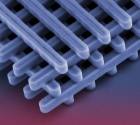
Molecular memory is regarded by some as the next big evolution in memory storage, looking to supplant Dynamic random access memory (DRAM) as a cheaper option for high-speed computing. Molecular memory relies on the existence of certain bistable molecules which may be induced to switch between states based on electric input. Typically this bistability relies on oxidation and reduction reactions in which an electron is either donated or received by the molecule. These reactions are dependent on the electrical environment around each molecule, and new technology promises to ease and standardize the control of such environments. A collaboration between labs in UCLA and the California Institute of Technology has recently published an article in Nature decribing a 160-kilobit memory device using these molecular switches in combination with nanowire meshes to create controllable electronic environments. Nanowires are similar to nanotubes, except that they may consist of materials other than carbon - in this case Silicon and Titanium - that may result in unique conductive properties. In this device, the silicon and titanium nanowires cross eachother in a checkerboard pattern (see figure) with bistable molecules at each intersection. Manipulation of each nanowire controls the state of each switch and serves as a miniscule bit of memory on the order of 100 billion bits per square centimeter.
Nanotubes consist of a lattice of carbon atoms curved into a cylinder (see figure) of about 1-2 nanometers in diameter. They may be produced via arc-discharge methods to make multi-walled nanotubes (MWNT) or via laser ablation or chemical vapor deposition to make single-walled carbon nanotubes (SWNT). See this site on nanotube production for a description of these methods.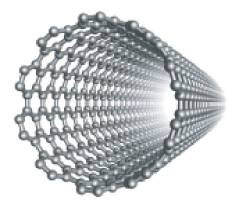 Nanotubes are a very popular aspect of nanotechnology because of the interesting features that they possess. SWNTs have strengths determined to be 50-100 times that of steel and with an elasticity on the order of terrapascals, which is among the most elastic materials on Earth. Moreover, nanotubes have a higher thermal conductivity than any natural material and 100 times the electrical conductivity of copper, the most commonly used conductor in electronics. Nanotubes have a density half that of aluminum and, to top it off, are stable of temperatures exceeding 2700 degrees C.ApplicationsOne of the mort commonly sited applications of carbon nanotubes is for use in electronics as nano-sized transistors. Their size and manipulatability in the nano levels are promising as we attempt to keep up with Moore's law to create smaller and smaller chips. Moreover, the potential of nanotubes for superconductivity drastically reduces the heat waste in transmission that creates such a problem in today's computers. Though the technology is still in its relative infancy, nanotubes look to be the next revolution in chip-making that will allow us to keep up with the breathtaking progression that Moore's law predicts.Their amazing mechanical properties give nanotubes many other potential applications as well. For instance, nanotubes are being used in bikes in the Tour de France and being researched as materials for use in space by NASA. As production of carbon nanotubes becomes cheaper and more precise, their applications will surely multiply.
OverviewStarpharma Holdings Ltd. claims to be the world leader in using dendimer-based nanotechnology for pharmaceutical development. Starpharma was founded in 1996 out of the Biomolecular Research Institute (BRI) and is currently traded on the Australian Stock Exchange (ASX). The company specializes in using dendrimer technology to create pharmaceuticals aiding in the prevention of STDs, including herpes and HIV. Starpharma has received over $20M in government grants (NIH) and recently acquired Dendritic Nanotechnologies (DNT) in order to strengthen research into further denrimer applications. Starpharma has a market cap of around $89M.Starpharma.comProductsVivaGelTM - This gel-based STD preventative is the most advanced of Starpharma's pharmaceuticals. VivaGel has successfully tested in Phase I clinical trials and is currently testing in the US, Australia, and Kenya. Based on its potentially critical role in preventing STDs, the FDA has granted VivaGel Fast Track status through its regulatory process.News10.10.2006- Starpharma acquired DNT for approximitely $14M. The acquisition provides Starpharma with strengthened control over primary dendrimer development and gives Starpharma ownership over additional dendrimer patents, making Starpharma the leader in holding such patents. Starpharma had previously held a 33% stake in DNT.1.9.2006- VivaGel received Fast Track status from the FDA.10.3.2005- Starpharma received $20M from the NIH to further develop VivaGel.4.1.2005- Starpharma received AUD$5.7M from the Australian government to pursue dendrimer-based pharmaceutical development.
Dendrimers are carbon-based polymers consisting of several branched monomers, called dendrons, surrounding a central core (see figure). Dendrimers consist of the core, the branches, and the end groups that exist at the end of the outermost monomers.

The properties of dendrimers can be altered by several means. First, the size of the dendrimers created is highly manipulatable. Dendrimers are produced in iterative sequences of reaction steps, with each iteration creating one additional layer of monomer branches. Each reaction effectively doubles the molecular weight of the dendrimer as well as the amount of active end groups at the edge of the dendrimer, allowing for the creation of very well defined structures. The end groups themselves also play an important role in the functionality of dendrimers. By altering these "active" groups, one may control the way in which dendrimers react with their immediate environment.
There are many potential applications of dendrimers in medicine. Due to their solubility in water, dendrimers may be used as nano-sized capsules through which to transport insoluble drugs in the human body. Dendrimers may essentially be used as highly manipulative biological coats designed to allow drugs to enter target cells without risking degradation or rejection. This coat function may also be used to deliver insoluble imaging agents to cells of interest for fluorescent imaging. Dendimers may also be made into insoluble scaffolds when specific cross-linking groups are used as the end groups. These insoluble scaffolds may be used to repair damaged tissue.
Dendimers are interesting because of the vast amount of potential functions that they offer. Simple alterations in dendrimer shape or end group composition can have profound effects on the properties of that dendrimer. Morover, the simple carbon makeup of these dendimers make them easily biodegradable and safe for medical use in humans. For a comprehensive review of dendimer properties and functions, see this article published in Nature Biotechnology.
Overview
Nanospectra is a private company founded by Dr. Jennifer West in 2002 in Houston, TX and largely funded from government grants. The company specializes in using gold-coated nanoshells to absorb near-IR light and destroy cancer tumor cells in a therapy dubbed Aurolase TM therapy. This method is quicker and more specific than chemotherapy and results in a substantial reduction of side effects. Aurolase TM therapy is currently in Phase I of clinical testing and is currently seeking FDA permission to enter Phase II clinical testing in human patients with head and neck cancer. Nanospectra.com
Recent News
11.02.2006- Nanospetra sold $1.7M of series A preferred stock in order to fund pilot trials for Phase II of the Aurolase TM therapy.
Collaborations
2007- Nanospectra received $1.25M from the Texas Emerging Technologies Fund (TETF) and $500K from the National Science foundation (NSF) to continue development and testing of the Aurolase TM cancer therapy.2005- Nanospectra received $392K from the NSF for cancer research and $750K from the US Air Force to research nanoshell applications in detecting harmful biological and chemical agents.
2004- Nanospectra received $428K from the National Institute of Health (NIH) to research nanoshell detection of plaques related to Alzheimer's disease and $2M from the NIST ATP award for cancer treatment.
At the level of nanometers, the world behaves under slightly different laws of physics from those we are used to. This can be illustrated with regard to color, the wavelength of light reflected by an object. A red piece of paper will remain red after being cut into smaller and smaller pieces until those pieces reach the level of nanometers. At this point, the interactions between “red paper” molecules begin undergo alterations which may affect the light reflected by the particles and change their perceived color.
Nanoshells are spherical nanoparticles with a silica core surrounded by a gold coat ranging from 5-20nm in thickness. By altering the thickness of the gold coat, researchers take advantage of the special laws obeyed on the nano level to change the spectrum of light absorbed most strongly by the shells. Moreover, shining light within this absorption spectra on these shells causes them to heat up and kill surrounding tissue. This phenomenon is useful for eliminating tumor cells in cancer.The small size of these nanoshells makes it easy for researchers to administer the shells through bloodstream into the tissue of interest. Researchers may coat the nanoshells with anitbodies designed to localize to tumor cells and tune the absorption spectra of the shells to match the light most strongly absorbed in these tissues. A lab in Rice University led by Dr. Jennifer West has recently shown these nanoshells to be useful in eliminating tumor cells in (here). Nanoshells may also be tuned to scatter certain wavelengths of light. This has proven useful for imaging tumor cells and may have other uses for optical imaging as well.
A group led by Dr. Gerald E. Schneider in MIT recently published a paper which found that injecting a class of self-assembling proteins called "sapeptides" can promote nerve fiber regrowth in severed optic tracts of hamsters. The optic tract is the nerve bundle that connects that retina of the eye to the brain, and is crucial to the process by which we integrate the light that we sense into the intricate representations of the world that we experience. While the extent to which the experience of vision restored in these hamsters is unknown, the lab found that the regenerated hamsters were able to respond to and follow visual stimuli (demonstated by head movements from the hamsters).
The sapeptides are short and simple sequences of about a dozen of amino acids joined into oligopeptides. These peptides self assemble in physiological conditions to form scaffolds around damaged tissue. Though the mechanism of regeneration is unknown, these scaffolds have been shown to promote regeneration of tissue ranging from optic tract nerves to damaged pancreatic cells.
Sapeptides are interesting because of their self assembling nature and the fact that their components - simple amino acids - are easily degraded by natural physiological processes. Nothing has been tested in humans, but the possibilities of biomaterial mediated tissue regeneration are very encouraging. Imagine the potential of these scaffolds when combined with stem cell therapy...
Today I will post my first informational post. This post will profile a new class of self-assembling protein scaffolds which can be injected into damaged tissue to promote regeneration. One lab in MIT found that injection of these "sapeptides" can result in regeneration of severed nerve fibers from the eye of hamsters, restoring vision. Just think, one day injections of these proteins may help stroke victims and Alzheimer's patients regenerate brain tissue and improve their lives.
This post will mark the start of my commitment to this blog. I hope to make 3-4 posts per week and I will provide equal coverage to the science behind nanotechnology as to the companies applying nanotechnology to better our lives.
This blog will have three main components:
1) Technology Reviews will be short reviews of new technologies in nanoscience. They will consist of information gathered through primary literature reviews from academia, and references will always be posted at the end of each review.
2) Company Profiles will be profiles of companies aiming to take advantage of technologies highlighted in the reviews sections. The profiles will include company goals, the product, potential markets, and funding among other factors. Reviews of the relevant technology used by these companies will be linked to their profiles.
3) News will highlight current news on the nanotechnology front. This can include government funding initiatives, products made available to the common public, or interesting information developing in the field.
My name is William Raasch, and I am finishing up my final year at Stanford University as a biology major with a specialization in neuroscience. As a biologist, I have always made an effort to keep my eye on the forefront of research and technology, and nanotechnology has recently struck me with its potential to revolutionize our method of progress in a wide range of fields. Creation of materials using the bottom-up approach afforded by nanotechnology will spur research and development in many fields - from electronics to materials science to biotechnology - and I intend to keep myself as involved as possible in the progress.
The purpose of this site is to keep readers up to date with the quickly developing trends in nanoscience and nanotechnology. The site will be geared toward reviewing new technologies and profiling those companies currently taking advantage of the technologies. The mission of this blog is to chronicle nanotechnology in a manner that is both readable and enjoyable for anybody interested in the progress of this exciting new field.
If there are ever any questions or comments regarding this blog, feel free to contact me at: wraasch@stanford.edu